ImageTool
Inspired by Image Tool for Igor Pro, developed by the Advanced Light Source at Lawrence Berkeley National Laboratory, ImageTool delivers the same efficient workflow, now enhanced by xarray and Python.
Key capabilities
Responsive slicing of multidimensional (up to 4D)
DataArrayobjects, including Dask-backed data.Unlimited number of cursors with independent binning and code export for each line cut.
Rich colormap controls with power law scaling, midpoint-aware scaling, and live color range adjustment.
Built-in menus for rotation, symmetrization, averaging, cropping, coordinate reassignment, Fermi edge correction, and other common operations.
Tight integration with common analysis helper tools such as ktool, dtool, and other tools listed in Other interactive tools, all accessible from ImageTool’s menus and context menus.
Seamless integration with ImageTool manager when you need to organize many windows, share workspaces, or synchronize with Jupyter notebooks.
Launching ImageTool
ImageTool expects image-like data—usually a DataArray—with 2–4 dimensions. ImageTool tries to handle incompatible input dimensions by adding a new dimension for 1D data and squeezing out dimensions of size 1 for 5D+ data. Non-uniform coordinates gain parallel _idx indices so you can still slice by position. Supported inputs include numpy arrays, Dataset, or entire DataTree objects; Dataset and DataTree inputs open one ImageTool window per valid variable.
Entry points
Use the
xarray.DataArray.qshow()accessor on your data:data.qshow(link=True)
Call
erlab.interactive.imagetool.itool()directly:import erlab.interactive as eri eri.itool(data, cmap="cividis")
Passing a list or dataset to
itoolspawns multiple windows; setlink=Trueto synchronize their cursor positions and bins.Launch ImageTool from IPython or a notebook using the
%itoolline magic. Load the extension first:%load_ext erlab.interactive
Then run:
%itool data
where
datais a variable in the current namespace. You can pass additional flags, such as-mor--managerwhich sends the window straight to the manager. Type%itool --helpor%itool?to list all supported flags.Need to open a file quickly? Use File → Open… inside ImageTool. The dialog lists every available loader, including those from data loader plugins, so you can switch between formats without writing code.
If you are using VS Code, you can open a DataArray in ImageTool directly from the GUI with the
erlabextension ( marketplace | open-vsx ).
Notebook auto-loading
Add erlab.interactive to your IPython configuration so %itool is ready whenever a notebook starts.
Tip
If you use VS Code with the Jupyter extension, add this to your workspace or user settings.json:
"jupyter.runStartupCommands": [
    "%load_ext erlab.interactive"
]
To integrate ImageTool windows with notebook variables—including bi-directional updates—switch to the ImageTool manager and use the %watch magic described in Notebook integration.
Round-trip
Start from Python with xarray.DataArray.qshow(),
erlab.interactive.imagetool.itool(), or %itool, then use
Copy selection code or dialog Copy Code to move the chosen
selection or transform back into a notebook. If edits should update a live notebook
variable instead of the clipboard, move the window to the manager and use %watch.
The full GUI/API mapping lives in Operation map.
Interface tour
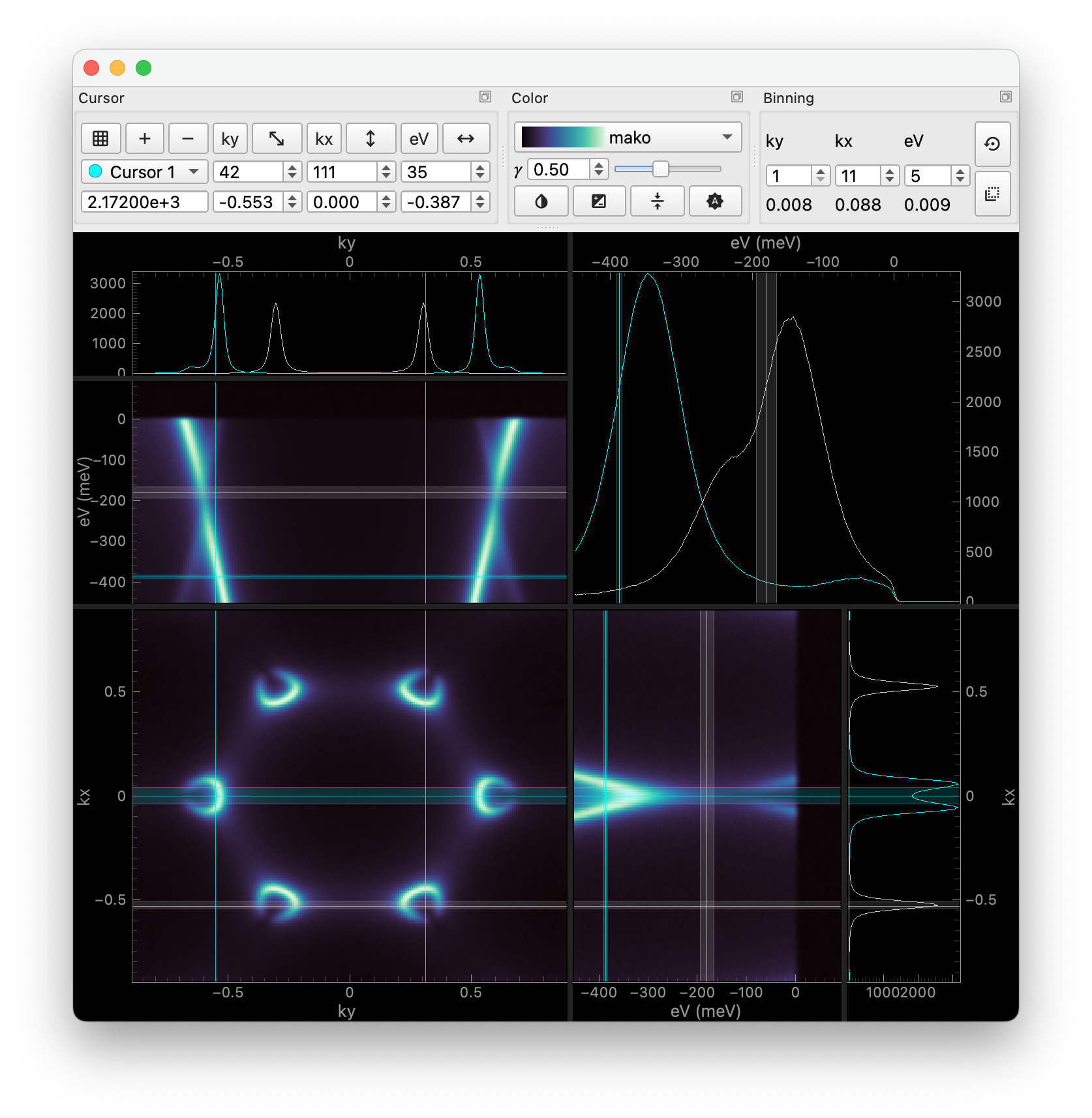
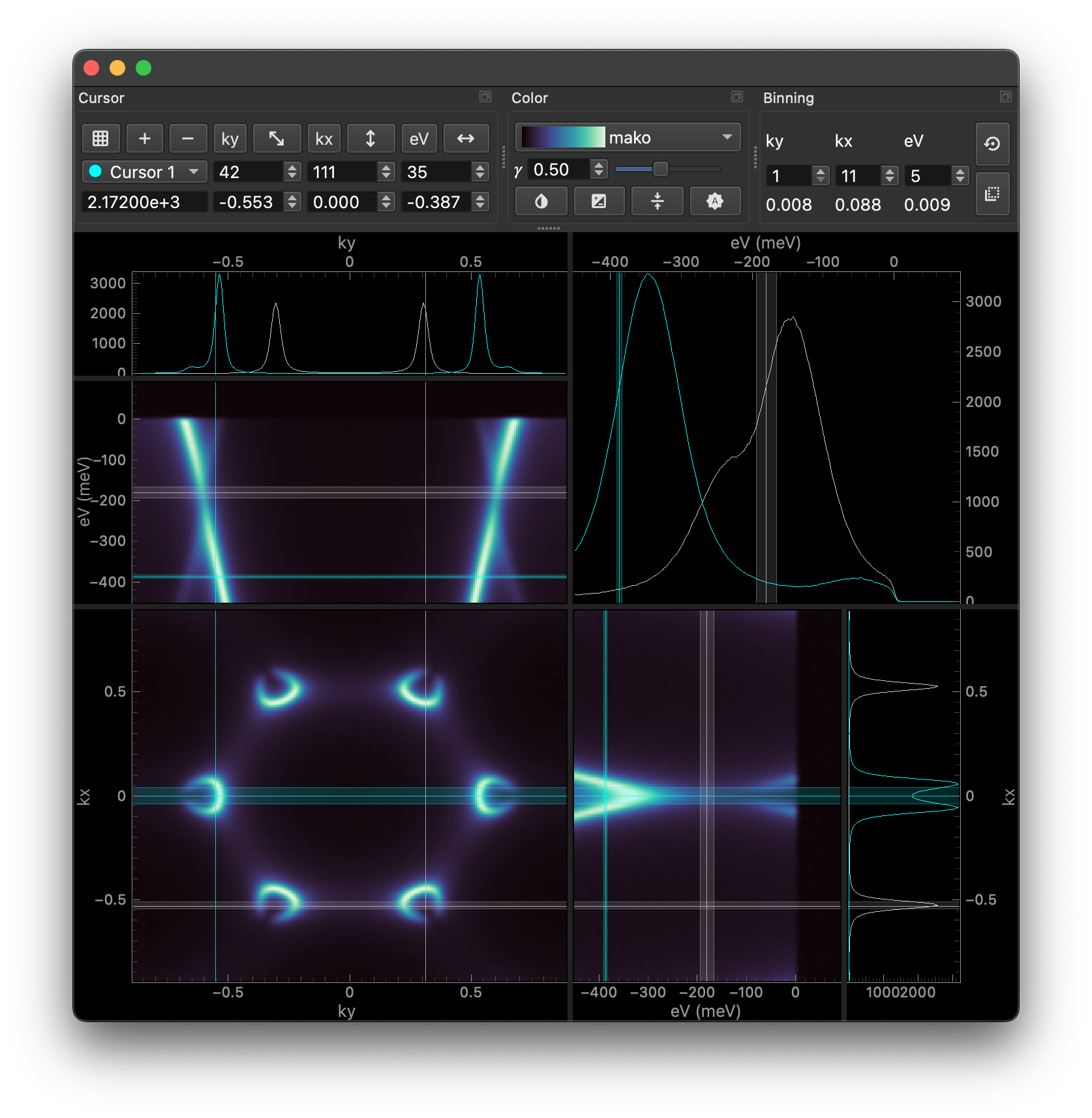
Every ImageTool window is built from an ImageSlicerArea plus dockable control panels:
Main image and cross-sections – The central plot renders the current 2D slice. Orthogonal slices and cursor readouts update in real time as you move the cursors.
Cursor panel – Add, remove, and modify cursors here. The coordinates of the active cursor are shown in editable text boxes.
Color panel – Manipulate colormap normalization and appearance.
Binning panel – Set bin widths per dimension and reset them with . Changes to the bin widths you make while is toggled are applied to all cursors.
Working with dimensions and coordinates
The order of dimensions can be swapped using the arrow buttons in the cursor panel. The direction of the arrow intuitively indicates which slice will be swapped with the main view.
Non-uniform coordinates are converted with a
_idxsuffix for plotting. Their true values are displayed in the cursor readouts.Use Edit → Edit Coordinates to open the Coordinate Editor dialog. This is just a GUI for
xarray.DataArray.assign_coords()that lets you specify start/end values or per-point overrides.Dask-backed arrays are fully supported. The dedicated Dask menu exposes actions to compute the array into memory, rechunk automatically, or choose custom chunk shapes within ImageTool.
Overlay plots of non-dimensional coordinates (e.g., temperature) on the data from View → Plot Associated Coordinates.
Slicing, binning, and linking
Drag with the left mouse button to pan and with the right mouse button (or the wheel) to zoom. Scroll on individual axes to zoom along a single dimension.
To change the slicing position, drag on a cursor line to move it, or drag on the plots while holding Ctrl. You can also use the keyboard shortcuts listed in the View → Cursor Control submenu which allow precise nudging of the active cursor with arrow keys.
When binning is enabled, the data shown are an average over the specified bin widths, which are indicated by shaded regions near the cursor lines.
When comparing data in several ImageTool windows, you can link them either at creation (
eri.itool([data1, data2], link=True)) or inside the manager. Linked windows maintain synchronized slicing positions, bin widths, and cursor counts.
Color and normalization
Toggle to lock the color range to the global data min/max and display a colorbar alongside the image. Drag on the colorbar to update limits interactively or right-click to type exact bounds.
applies gamma scaling relative to the midpoint, which is handy for centered intensity scales such as spin-polarized or dichroic data.
Use to flip between normalization behaviors of
matplotlib.colors.PowerNormanderlab.plotting.colors.InversePowerNorm.By default, only a subset of Matplotlib colormaps is loaded. You can load the whole catalog by right-clicking on the colormap drop-down and selecting Load All Colormaps.
Editing and filtering data
Editing dialogs live under the Edit and View menus. Most transforms are destructive yet provide an Open in New Window checkbox so you can keep the original data. When Copy Code is available, the generated snippet is placed on your clipboard, ready to paste into a script or notebook for reproducibility.
Edit → Rotate opens the Rotate dialog. Enter the angle, center, interpolation order, and whether to reshape the image. If a rotation guideline is active, the dialog pre-fills the matching angle and pivot.
Edit → Average opens the Average Over Dimensions dialog. Select any set of dimensions to average via
xarray.DataArray.qsel.average().Edit → Symmetrize opens the Symmetrize dialog. Mirror a selected dimension about a specified center with additive or subtractive symmetry,
validorfulloverlap, and one-sided or two-sided output.Edit → Crop opens the Crop Between Cursors dialog, while Edit → Crop to View opens the Crop to View dialog.
Edit → Correct With Edge… opens the Edge Correction dialog. If your data exposes an
eVaxis, ImageTool can import a previously fitted edge viaxarray_lmfit.load_fit()and shift the spectrum accordingly.View → Normalize opens the Normalize dialog, a non-destructive filter that supports area normalization, min-max scaling, and baseline subtraction.
Edit → Edit Coordinates opens the Coordinate Editor dialog for precise coordinate reassignment, including non-uniform axes.
Use Edit → Undo and Edit → Redo to walk changes back, and View → Reset to remove any currently applied filter function. ImageTool also keeps track of additional helper windows opened from the context menus, so everything is closed cleanly when the main window exits.
Regions of Interest (ROIs)
ROIs let you focus on a sub-region of the data. They can be created and manipulated directly on the image plot.
Only polygonal ROIs with arbitrary vertex counts are supported at this time.
Create and manipulate
Right-click on an image plot and choose Add Polygon ROI. A two-point line appears near the active cursor so you can immediately drag it into place.
Drag any handle to move a vertex. Click on a segment to insert a new vertex.
Right-click on a ROI and pick Edit ROI… to open a tabular editor.
The coordinate table lists every vertex of the ROI.
Check the Closed option to convert an open polyline into a filled polygon.
Edits are logged, so you can undo accidental drags with Ctrl+Z.
ROI-driven analysis
Two additional context-menu actions appear upon right-clicking on a ROI:
Slice Along ROI Path interpolates the data with
erlab.analysis.interpolate.slice_along_path().Choose a step size and a name for the new path dimension, then decide whether to open the result in a new window or replace the current data.
Mask Data with ROI calls
erlab.analysis.mask.mask_with_polygon()to mask the data with the ROI.You can choose whether to invert the mask and whether to trim the resulting data.
Note that both procedures work on the entire data volume, not just the visible slice.
Python equivalent
ImageTool is the GUI counterpart to the core selection and transform APIs: .sel(...),
.isel(...), xarray.DataArray.qsel.average(),
erlab.analysis.transform.rotate(),
erlab.analysis.transform.symmetrize(),
xarray.DataArray.assign_coords(),
erlab.analysis.interpolate.slice_along_path(), and
erlab.analysis.mask.mask_with_polygon().
Use the tool to discover parameters quickly, then keep the exact public API call in Python. See Operation map for the maintained crosswalk.
Exporting and settings
File → Save As… exports the current data to NetCDF or HDF5.
File → Move to Manager hands the window off to the ImageTool manager.
File → Settings opens the shared settings dialog described in Configuration.
Keyboard shortcuts
Most actions advertise their shortcut directly in the menu bar. The table below highlights common gestures. Replace Ctrl with ⌘ and Alt with ⌥ on macOS.
Shortcut |
Description |
|---|---|
LMB Drag |
Pan |
RMB Drag |
Zoom and scale |
Ctrl+LMB Drag |
Move active cursor |
Ctrl+Alt+LMB Drag |
Move all cursors simultaneously |
Alt while dragging a cursor line |
Move all cursor lines along |
Rule of thumb: hold Alt to apply actions to all cursors. Shortcuts for ‘shifting’ a cursor involves the Shift key.