erlab.interactive.imagetool.manager
Manager for multiple ImageTool windows.
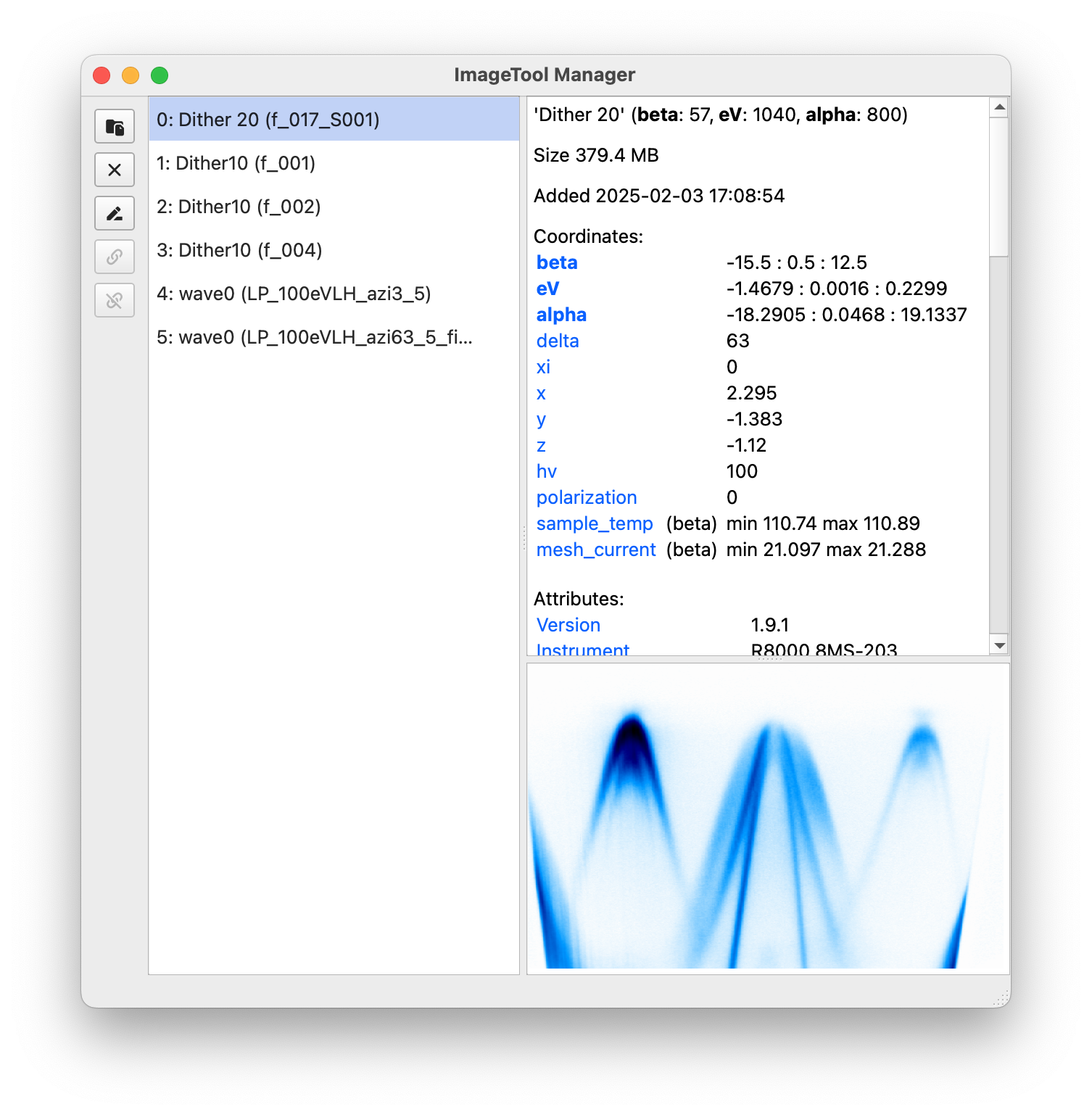
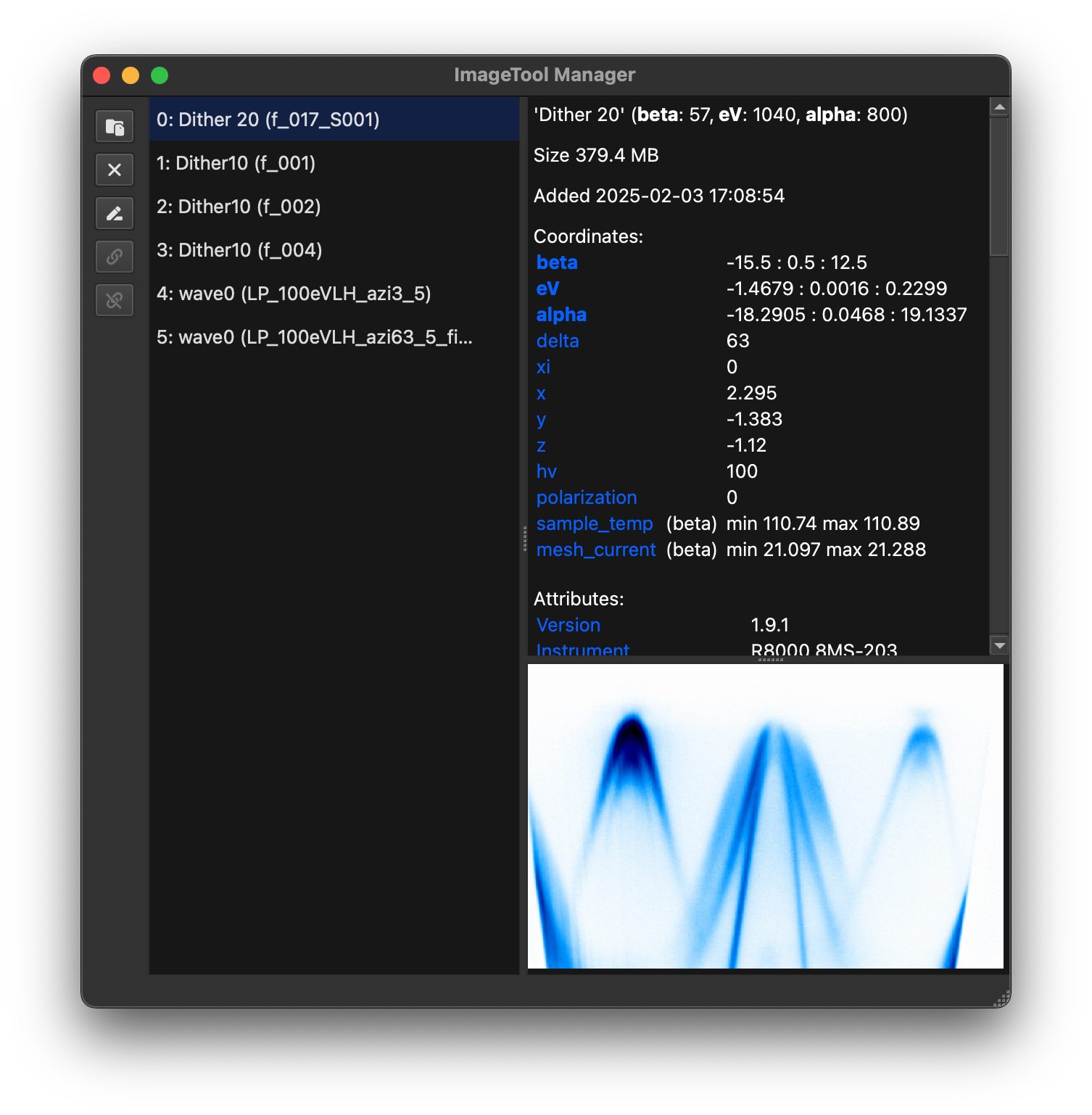
This module provides a GUI application for managing multiple ImageTool windows. The
application can be started by running the script itool-manager from the command line
in the environment where the package is installed.
Python scripts communicate with the manager using a ZeroMQ connection with the default
port number 45555. The port number can be changed by setting the environment variable
ITOOL_MANAGER_PORT.
Functions
|
Get data from the ImageTool window at the given index. |
Return the path to the log file used by ImageTool Manager. |
|
Check whether an instance of ImageToolManager is active. |
|
|
Load and display data in the ImageToolManager. |
|
Start the ImageToolManager application. |
|
Push changed variables to manager for a given shell or namespace. |
|
Replace data in existing ImageTool windows. |
|
Create and display ImageTool windows in the ImageToolManager. |
|
Shutdown watcher for a namespace and unregister associated hooks. |
|
Watch namespace variables and synchronize them with ImageTool manager. |
|
Return currently watched variable names for the selected namespace. |
Classes
The ImageToolManager window. |
- class erlab.interactive.imagetool.manager.ImageToolManager[source]
Bases:
QMainWindowThe ImageToolManager window.
This class implements a GUI application for managing multiple ImageTool windows.
Users do not need to create an instance of this class directly. Instead, use the command line script
itool-manageror the functionmainto start the application.- Signals:
sigLinkersChanged() – Signal emitted when the linker state is changed.
- add_childtool(tool, index, *, show=True)[source]
Register a child tool window.
This is mainly used for handling tool windows such as goldtool and dtool opened from child ImageTool windows.
- Parameters:
tool (
ToolWindow) – The tool window to add.index (
int) – Index of the parent ImageTool window.show (
bool, default:True) – Whether to show the tool window after adding it, by defaultTrue.
- add_imagetool(tool, *, show=True, activate=False, watched_var=None)[source]
Add a new ImageTool window to the manager and show it.
- Parameters:
tool (
ImageTool) – ImageTool object to be added.show (
bool, default:True) – Whether to show the window after adding, by defaultTrue.activate (
bool, default:False) – Whether to focus on the window after adding, by defaultFalse.watched_var (
tuple[str,str] |None, default:None) – If the tool is created from a watched variable, this should be a tuple of the variable name and its unique ID.
- Returns:
int– Index of the added ImageTool window.- Return type:
- add_widget(widget)[source]
Save a reference to an additional window widget.
This is mainly used for handling tool windows such as goldtool and dtool opened from child ImageTool windows. This way, they can stay open even when the ImageTool that opened them is archived or removed.
All additional windows are closed when the manager is closed.
Only pass widgets that are not associated with a parent widget.
- Parameters:
widget (
QWidget) – The widget to add.
- color_for_watched_var_kernel(kernel_uid)[source]
Return a different color for different source kernels.
- concat_selected()[source]
Concatenate the selected data using
xarray.concat().
- duplicate_imagetool(index)[source]
Duplicate the ImageTool window corresponding to the given index.
- eventFilter(obj=None, event=None)[source]
Event filter that intercepts select all and copy shortcuts.
For some operating systems, shortcuts are often intercepted by actions in the menu bar. This filter ensures that the shortcuts work as expected when the target widget has focus.
- get_childtool(uid)[source]
Get the child tool window corresponding to the given UID.
- Parameters:
uid (
str) – The unique ID of the child tool to get.- Returns:
ToolWindow– The child tool window corresponding to the given UID.- Return type:
- get_imagetool(index, unarchive=True)[source]
Get the ImageTool object corresponding to the given index.
- Parameters:
- Returns:
ImageTool– The ImageTool object corresponding to the index.- Return type:
- label_of_imagetool(index)[source]
Get the label of the ImageTool window corresponding to the given index.
- link_imagetools(*indices, link_colors=True)[source]
Link the ImageTool windows corresponding to the given indices.
- name_of_imagetool(index)[source]
Get the name of the ImageTool window corresponding to the given index.
- remove_imagetool(index, *, update_view=True)[source]
Remove the ImageTool window corresponding to the given index.
- rename_imagetool(index, new_name)[source]
Rename the ImageTool window corresponding to the given index.
- erlab.interactive.imagetool.manager.fetch(index)[source]
Get data from the ImageTool window at the given index.
- Parameters:
index (
int|str) – Index of the ImageTool window to get data from, or the unique identifier (UID) of a watched variable (used internally).- Returns:
xr.DataArrayorNone– The data in the ImageTool window at the given index, orNoneif the index is invalid or the data cannot be retrieved.- Return type:
DataArray | None
- erlab.interactive.imagetool.manager.get_log_file_path()[source]
Return the path to the log file used by ImageTool Manager.
- erlab.interactive.imagetool.manager.is_running()[source]
Check whether an instance of ImageToolManager is active.
- erlab.interactive.imagetool.manager.load_in_manager(paths, loader_name=None, **load_kwargs)[source]
Load and display data in the ImageToolManager.
- Parameters:
paths (
Iterable[str|PathLike]) – List of paths containing the data to be displayed in the ImageTool window.loader_name (
str|None, default:None) – Name of the loader to use to load the data. The loader must be registered inerlab.io.loaders.**load_kwargs – Additional keyword arguments passed onto the load method of the loader.
- erlab.interactive.imagetool.manager.main(execute=True)[source]
Start the ImageToolManager application.
Running
itool-managerfrom a shell will invoke this function.
- erlab.interactive.imagetool.manager.maybe_push(*, shell=None, namespace=None)[source]
Push changed variables to manager for a given shell or namespace.
In IPython kernels with
post_run_cellsupport, this is usually not required because pushes are triggered automatically after each cell. In environments that rely on polling (for example, marimo), this can be used to force an immediate check outside the polling cadence.- Parameters:
shell (
_ShellProtocol|None, default:None) – Shell-like object exposinguser_ns. This takes precedence overnamespacewhen both are given.namespace (
MutableMapping[str,Any] |None, default:None) – Namespace mapping used only whenshellis not provided. By default, marimo kernel globals are used when running in marimo; otherwise the caller module globals are used if no IPython shell is detected.
- erlab.interactive.imagetool.manager.replace_data(index, data)[source]
Replace data in existing ImageTool windows.
- Parameters:
index (
int|Collection[int]) – Index or indices of the ImageTool windows to replace data in. Ifdatacorresponds to a single ImageTool window, for instance a single DataArray,indexis allowed to be a single integer. Ifdatacorresponds to multiple ImageTool windows, for instance a list of DataArrays,indexmust be a list of integers with the same length asdata. All indices must be valid indices of existing ImageTool windows.data (
Collection[DataArray|ndarray[tuple[Any,...],dtype[TypeVar(_ScalarT, bound=generic)]]] |DataArray|ndarray[tuple[Any,...],dtype[TypeVar(_ScalarT, bound=generic)]] |Dataset|DataTree) – Data to replace the existing data in the ImageTool windows. Seeitoolfor more information.
- erlab.interactive.imagetool.manager.show_in_manager(data, **kwargs)[source]
Create and display ImageTool windows in the ImageToolManager.
- Parameters:
data (
Collection[DataArray|ndarray[tuple[Any,...],dtype[TypeVar(_ScalarT, bound=generic)]]] |DataArray|ndarray[tuple[Any,...],dtype[TypeVar(_ScalarT, bound=generic)]] |Dataset|DataTree|None) – The data to be displayed in the ImageTool window. Seeitoolfor more information.link – Whether to enable linking between multiple ImageTool windows, by default
False.link_colors – Whether to link the color maps between multiple linked ImageTool windows, by default
True.**kwargs – Keyword arguments passed onto
ImageTool.
- erlab.interactive.imagetool.manager.shutdown(*, shell=None, namespace=None, remove=False)[source]
Shutdown watcher for a namespace and unregister associated hooks.
This removes IPython
post_run_cellcallbacks when present and stops fallback polling threads used in non-IPython environments.- Parameters:
shell (
_ShellProtocol|None, default:None) – Shell-like object exposinguser_ns. This takes precedence overnamespacewhen both are given.namespace (
MutableMapping[str,Any] |None, default:None) – Namespace mapping used only whenshellis not provided. By default, marimo kernel globals are used when running in marimo; otherwise the caller module globals are used if no IPython shell is detected.remove (
bool, default:False) – IfTrue, remove watched variables from manager while shutting down.
- erlab.interactive.imagetool.manager.watch(*varnames, shell=None, namespace=None, stop=False, remove=False, stop_all=False, poll_interval_s=0.25)[source]
Watch namespace variables and synchronize them with ImageTool manager.
Target resolution follows a shell-first policy:
If
shellis provided,shell.user_nsis always used.Else if
namespaceis provided, that mapping is used.Else, try the active IPython shell.
If no IPython shell is available, use marimo kernel globals when running in marimo; otherwise fall back to the caller module globals.
In most cases, simply using
watch("varname")without specifyingshellornamespaceshould work as expected in both IPython and regular Python scripts.Synchronization behavior differs by environment:
IPython kernels that expose a
post_run_cellevent use that event hook to detect outbound variable changes, so synchronization is done immediately after each cell execution.Other environments (for example, marimo or plain Python namespaces) use a background polling thread to detect outbound changes. The polling interval can be configured with
poll_interval_s. When using polling, changes are pushed to the manager at most once perpoll_interval_sseconds.
For inbound updates from the ImageTool manager, shells that expose
kernel.io_loop(typical IPython kernels) schedule namespace mutation on the kernel event loop. Other shells apply updates directly on the watcher thread.- Parameters:
*varnames (
str) – Variable names to watch or stop watching.shell (
_ShellProtocol|None, default:None) – Shell-like object exposinguser_ns. This takes precedence overnamespacewhen both are given.namespace (
MutableMapping[str,Any] |None, default:None) – Namespace mapping used only whenshellis not provided. By default, marimo kernel globals are used when running in marimo; otherwise the caller module globals are used if no IPython shell is detected.stop (
bool, default:False) – IfTrue, stop watching specified variables.remove (
bool, default:False) – IfTrue, remove watched variables from manager while stopping.stop_all (
bool, default:False) – IfTrue, stop watching all variables in the namespace.poll_interval_s (
float, default:0.25) – Polling interval in seconds for fallback polling when post-run hooks are unavailable (for example, non-IPython environments). Must be greater than 0. This value is ignored when a post-run callback is successfully registered.
- Returns:
tupleofstr– Currently watched variable names after applying the operation.- Return type:
- erlab.interactive.imagetool.manager.watched_variables(*, shell=None, namespace=None)[source]
Return currently watched variable names for the selected namespace.
Target resolution uses the same shell-first policy as
watch(): useshell.user_nswhenshellis provided, otherwise usenamespace. When neither is provided, the active IPython shell is used if available; otherwise caller globals are used.- Parameters:
shell (
_ShellProtocol|None, default:None) – Shell-like object exposinguser_ns. This takes precedence overnamespacewhen both are given.namespace (
MutableMapping[str,Any] |None, default:None) – Namespace mapping used only whenshellis not provided. By default, marimo kernel globals are used when running in marimo; otherwise the caller module globals are used if no IPython shell is detected.
- Returns:
- Return type: