ImageTool
The interactive image viewer and analyzer for ARPES spectra and other image-like data.
Workflow mainly involves a single ImageTool window for quick interactive exploration, with optional use of the ImageTool manager to organize and manage multiple ImageTool windows.
The ImageTool window
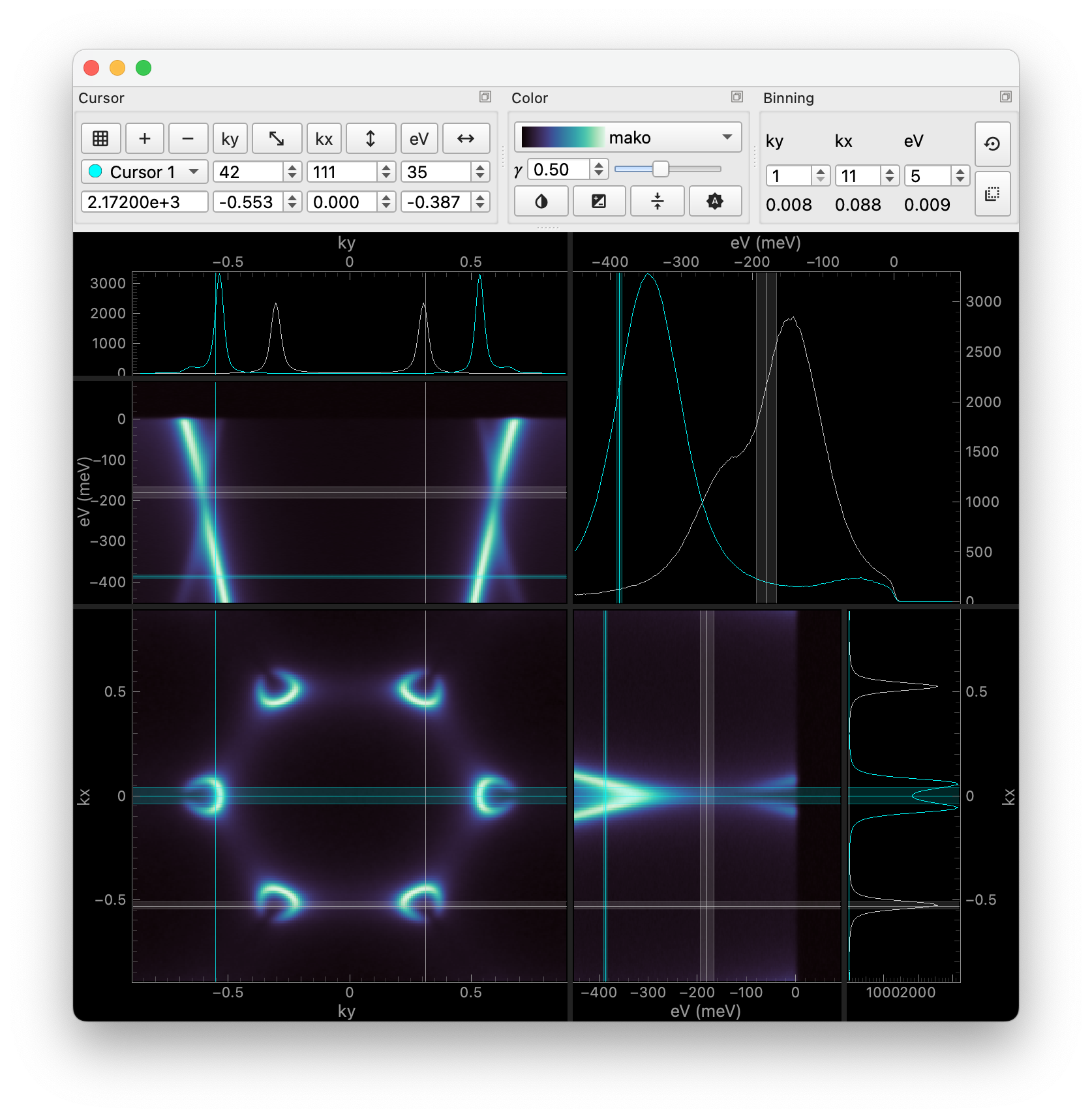
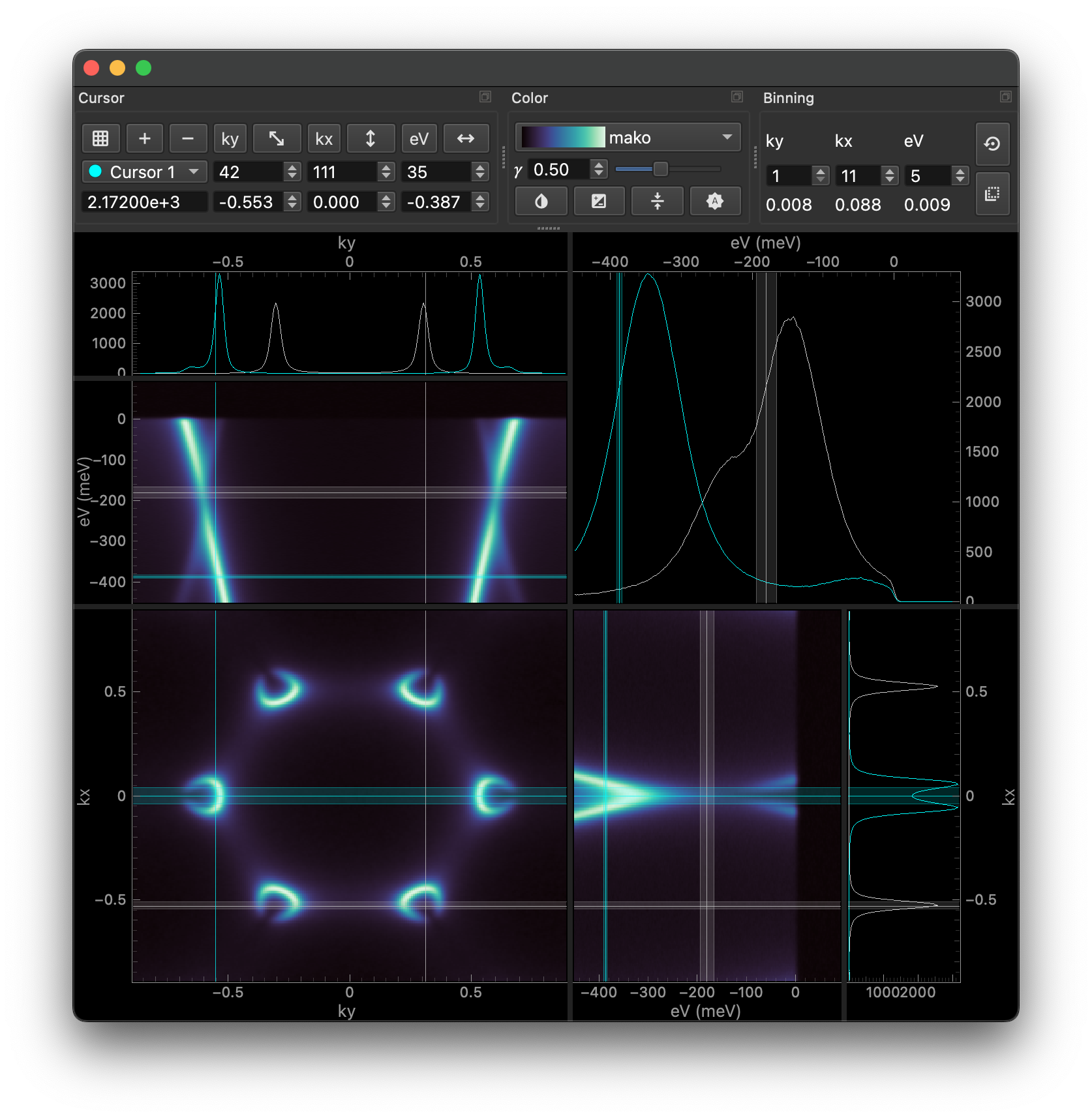
Inspired by Image Tool for Igor Pro, developed by the Advanced Light Source at Lawrence Berkeley National Laboratory, ImageTool is a simple yet powerful tool for interactive image exploration.
Features
Zoom and pan
Real-time slicing and binning
Multiple cursors
Easy size adjustment
Advanced colormap controls
Interactive editing: rotation, normalization, cropping, momentum conversion, and more
Displaying data in ImageTool
ImageTool supports image-like xarray.DataArray objects with 2 to 4 dimensions. Non-uniform coordinates are automatically converted to index arrays, which are suffixed with _idx.
There are several ways to display data in ImageTool:
Using
itool():import erlab.interactive as eri eri.itool(data)
Using the
xarray.DataArray.qshow()accessor:data.qshow()
In an interactive session, use the IPython magic command
%itool:If you are working in IPython or a Jupyter notebook, you can use the
%itoolmagic command to display data in ImageTool. First, load the IPython extension:%load_ext erlab.interactive
Then, display your data:
%itool data
This command is equivalent to calling
itool(). Many arguments toitool()are also available as options. For example, to open the data in the ImageTool manager, use the--manageroption (or-mfor short):%itool -m data
To see all supported arguments, run
%itool?in an IPython session.Working with the ImageTool manager: see the next section.
Tips
Hover over buttons for tooltips.
Most actions have associated keyboard shortcuts. Explore the menu bar to learn them.
Right-click on plots for context menus with options like copying slicing code, locking aspect ratio, exporting to a file, opening various tools, and more.
Hint
Holding Alt inside the context menu will transform some menu items to work with the data cropped to the currently visible area.
Cursor controls
: snap cursors to pixel centers.
and : add and remove cursors.
Color controls
: lock color range and display a colorbar.
When toggled on, the color range is locked to the minimum and maximum of the entire data.
The color range can be manually set by dragging or right-clicking on the colorbar.
: scale the colormap gamma with respect to the midpoint of the colormap, similar to
CenteredPowerNorm.: switch between scaling behaviors of
PowerNormandInversePowerNorm.You can choose different colormaps from the colormap dropdown menu. Only a subset of colormaps is loaded by default. To load all available colormaps, right-click on the colormap dropdown menu and select “Load All Colormaps”.
Binning controls
: reset all bin widths to 1.
: Apply binning changes to all cursors.
In the “Edit” and “View” menu bar items, you can find various options to edit and transform the data, such as rotating, symmetrizing, and cropping. Try them out!
ImageTool is extensible. At our home lab, we use a modified version of ImageTool to plot data as it is being collected in real-time!
Keyboard shortcuts
Some shortcuts that are not shown in the menu bar. Mac users must replace Ctrl with ⌘ and Alt with ⌥.
Shortcut |
Description |
|---|---|
LMB Drag |
Pan |
RMB Drag |
Zoom and scale |
Ctrl+LMB Drag |
Move active cursor |
Ctrl+Alt+LMB Drag |
Move all cursors |
Alt while dragging a cursor line |
Move all cursor lines |
Rule of thumb: hold Alt to apply actions to all cursors. Shortcuts for ‘shifting’ a cursor involves the Shift key.
ImageTool manager
ImageTools can also be opened in a manager window for organizing and managing multiple ImageTool windows, called ImageToolManager.
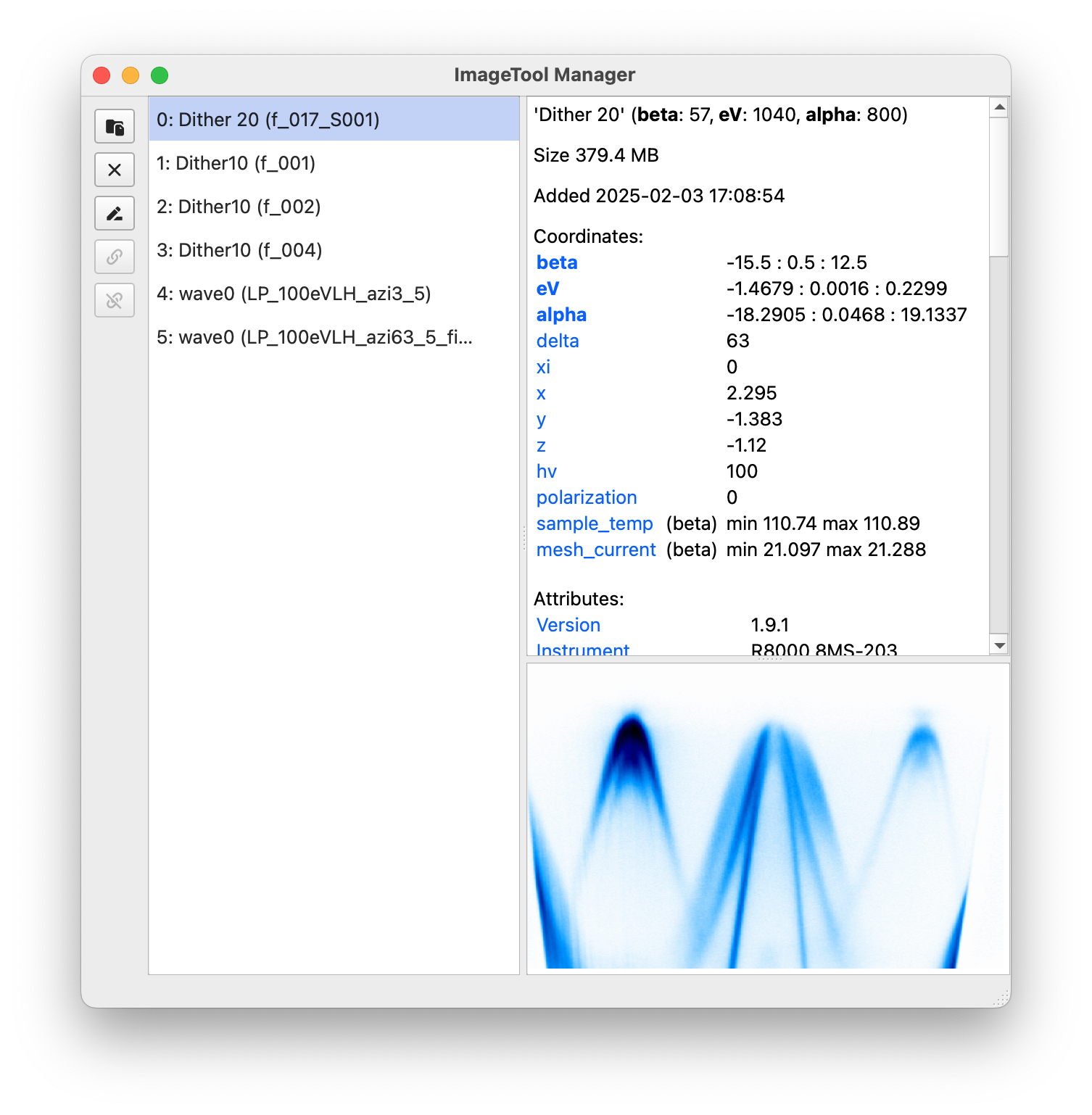
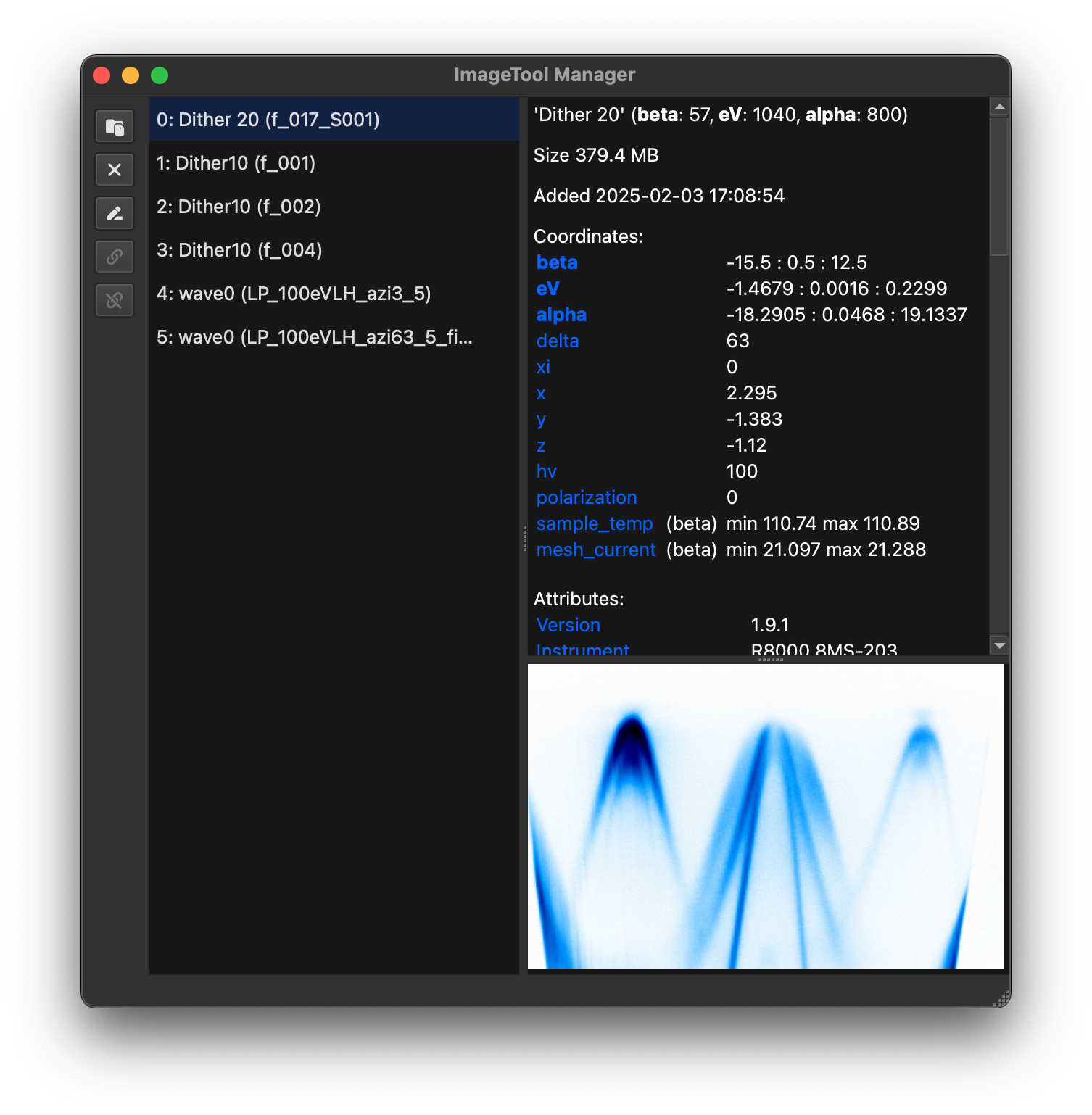
The manager shows a list of opened ImageTool windows along with some buttons. Information and preview about the data displayed in the currently selected ImageTool is shown in the right panel.
Hint
Hovering your mouse over each button will show a brief description of its function.
Starting the manager
Run itool-manager in a terminal or command prompt window in an environment where ERLabPy is installed.
Note
Only one manager can run per machine.
Opening an ImageTool window for the very first time may take a couple of minutes. Subsequent openings will be much faster.
The manager can be installed as a standalone application, which enables some convenient features. See Installing as a standalone application below for more information.
Adding ImageTool windows
When the manager is running, new data can be opened in the manager by:
Invoking ImageTool from
itool()orxarray.DataArray.qshow()withmanager=True.darr.qshow(manager=True)
Using the
%itoolmagic command with the--manager(or-m) option in an IPython session or Jupyter notebook.%itool -m darr
Watching a variable in a Jupyter notebook with the
%watchmagic command.See Working with notebooks below for more information.
The
Move to Manager(Ctrl+Shift+M) action in theFilemenu from an ImageTool window opened without specifyingmanager=True. This action moves the active ImageTool to the manager.Opening supported files through the
Filemenu in the manager.Dragging and dropping supported ARPES data into the manager window.
In the dialog that appears, you can choose the plugin to use for loading the data.
Hint
For scans that are recorded across multiple files, drag and dropping any file in the scan will automatically load and concatenate the entire scan. If you want to load only the file you dropped, choose the plugin suffixed with “Single File” in the dialog.
Saving and loading workspaces
You can save all open ImageTool windows to a file using the Save Workspace As... menu item in the manager. The workspace is saved as a single file with the .itws extension.
Later, restore your workspace with Open Workspace... or by dragging and dropping the workspace file into the manager.
Colormaps, cursor positions, window sizes, and other settings are preserved.
Workspace files are portable and can be shared with others, who can open them in their own ImageTool manager.
Additional features
Replace data in an existing ImageTool window by supplying the
replaceargument toitool()orxarray.DataArray.qshow():data.qshow(manager=True, replace=1)
To replace data in multiple windows at once:
eri.itool([data1, data2], manager=True, replace=[1, 2])
Save all ImageTool windows to a file via the
Save Workspace As...menu item.The saved windows can be restored later with
Open Workspace...or by dragging and dropping the file into the manager.The manager includes a built-in IPython console for manipulating ImageTool windows and data, and running Python code.
Toggle the console with ⌃+ (Mac) or Ctrl+ (Windows/Linux), or use the
Viewmenu.Hint
The console provides access to the
toolslist, which contains all open ImageTool windows. You can manipulate each window’s data via thedataattribute, e.g.,tools[0].data. The console is a full-featured IPython environment, supporting tab completion, magic commands, and other IPython features. For example, use the?operator to view function signatures and docstrings, e.g.,xr.concat?.Enable the
Preview on Hoveroption in theViewmenu to show a preview of the main image when hovering over each tool.After selecting multiple tools, you can perform actions on all selected tools at once using the right-click context menu.
Use the
Concatenateoption in the right-click context menu to combine data from all selected tools and open a new ImageTool window with the concatenated data. Seexarray.concatfor details.The manager features an integrated file browser for browsing and previewing data files. Access it from the
Filemenu or with the keyboard shortcut Ctrl+E.See
erlab.interactive.explorerfor more information.Explore the menu bar for additional features!
Working with notebooks
Synchronization
The ImageTool manager can automatically synchronize a Jupyter notebook variable with an ImageTool window. When the variable changes, the window updates automatically. If you transform the data in ImageTool (e.g., rotate, symmetrize, crop), the notebook variable is updated as well. We call this feature watching a variable.
First, load the IPython extension in your notebook:
%load_ext erlab.interactive
Note
To load the extension automatically in new notebooks, add erlab.interactive to your IPython config. See the IPython documentation for details.
If you use VS Code with the Jupyter extension, add this to your workspace or user settings.json:
"jupyter.runStartupCommands": [
    "%load_ext erlab.interactive"
]
Then watch a variable (e.g., my_data):
%watch my_data
This opens a new ImageTool window in the manager displaying my_data. When my_data changes, the window updates automatically. A label with the variable name appears next to the tool in the manager.
Note
Change detection runs after each cell execution. To avoid slow comparisons, only a subset of large arrays is checked. If an update is missed, force a refresh by re-running %watch my_data.
You can watch multiple variables:
%watch data1 data2 data3
List watched variables:
%watch
Stop watching specific variables:
%watch -d data1 data2
You can also stop watching from the tool’s right-click context menu in the manager.
If a variable is deleted or changed to a non-compatible type, it stops being watched:
del data1
data2 = "not a DataArray anymore"
The corresponding ImageTool windows become regular windows and no longer update automatically.
To stop watching and also close the corresponding windows:
%watch -x data1 data2
Stop watching all variables:
%watch -z
Combine with -x to also close all corresponding windows:
%watch -xz
Note
If you close the notebook or restart the kernel, watched variables remain in the manager but are no longer synchronized with the notebook. The corresponding windows keep their labels, but they no longer update automatically. You can remove the labels by right-clicking the tools and choosing “Stop Watching”. To avoid confusion, stop watching all variables before closing the notebook or restarting the kernel.
Accessing data from a notebook
Fetch data from a manager window by index with erlab.interactive.imagetool.manager.fetch():
from erlab.interactive.imagetool.manager import fetch
data = fetch(0)
Note
The fetched data is a copy. Modifying it does not affect the displayed data.
Integration with %store magic command
The %store magic command in IPython allows you to persist variables across different sessions. You can use this feature to store data from an ImageTool window in the manager and retrieve it later in any notebook session. The manager has built-in support for this feature, making it easy to store data from an ImageTool window using the %store magic command.
Suppose you want to store the data displayed in a tool with index 0. First select the tool in the manager. Then, trigger the Store with IPython action from the right-click context menu or the File menu. This will open a dialog to enter a variable name. Enter a variable name (e.g., my_data) and click OK.
Note
This is equivalent to running the following code in the manager console:
my_data = tools[0].data
%store my_data
Now, in any notebook, you can retrieve the data by running:
%store -r my_data
after which the data will be available as my_data in the notebook.
Installing as a standalone application
The ImageTool manager can be installed as a standalone application, which enables launching it without setting up a Python environment. It also enables some additional features:
Double-clicking supported files in your file explorer to open them in the manager.
Note
On macOS, this also includes drag-and-dropping supported files onto the application icon in the Dock.
Liquid glass icon on macOS 26 and later.
Builds for Windows and macOS can be downloaded from the releases page. Follow the instructions below to install the application.
For other platforms, build the application from source as described below.
Windows
Download the latest Windows build (a
.zipfile) from the releases page.Extract the contents of the
.zipfile and double click on the extracted.exefile to run the installer. Follow the prompts to complete the installation.
macOS
Download the latest macOS build
.zipfile from the releases page corresponding to your platform.Extract the contents of the
.zipfile. This will create anImageTool Manager.appfile.Move
ImageTool Manager.appto yourApplicationsfolder, or any desired location.
Updating the application
Updates can be checked and installed from within the application itself. Select Check for Updates... in the menu bar under ImageTool Manager (macOS) or Help (Windows) and follow the prompts.
Build from source
If you want to build the standalone application from source due to platform compatibility or other reasons, follow these steps:
Clone the repository:
git clone https://github.com/kmnhan/erlabpy.git
Navigate to the
erlabpydirectory:cd erlabpy
Install the required dependencies (assuming you have uv installed):
uv sync --all-extras --group pyinstaller --group pyqt6
Build the standalone application using PyInstaller:
uv run pyinstaller manager.spec
The built application will be located in
dist/ImageTool Manager.(Optional, Windows only) To create an installer, install Inno Setup and add to your system PATH. Then run:
iscc manager.issThe installer will be located in
dist.